Beauty product development goes beyond the formula
Building a beauty brand requires addressing several dimensions of the business at the same time. Brand identity and positioning shape how the brand is perceived; the business plan defines costs, margins, and investment needs; the legal framework ensures that each product can be marketed in compliance with applicable regulations; the commercial strategy determines distribution channels and pricing; and, ultimately, beauty product development turns an idea into a tangible product for consumers.
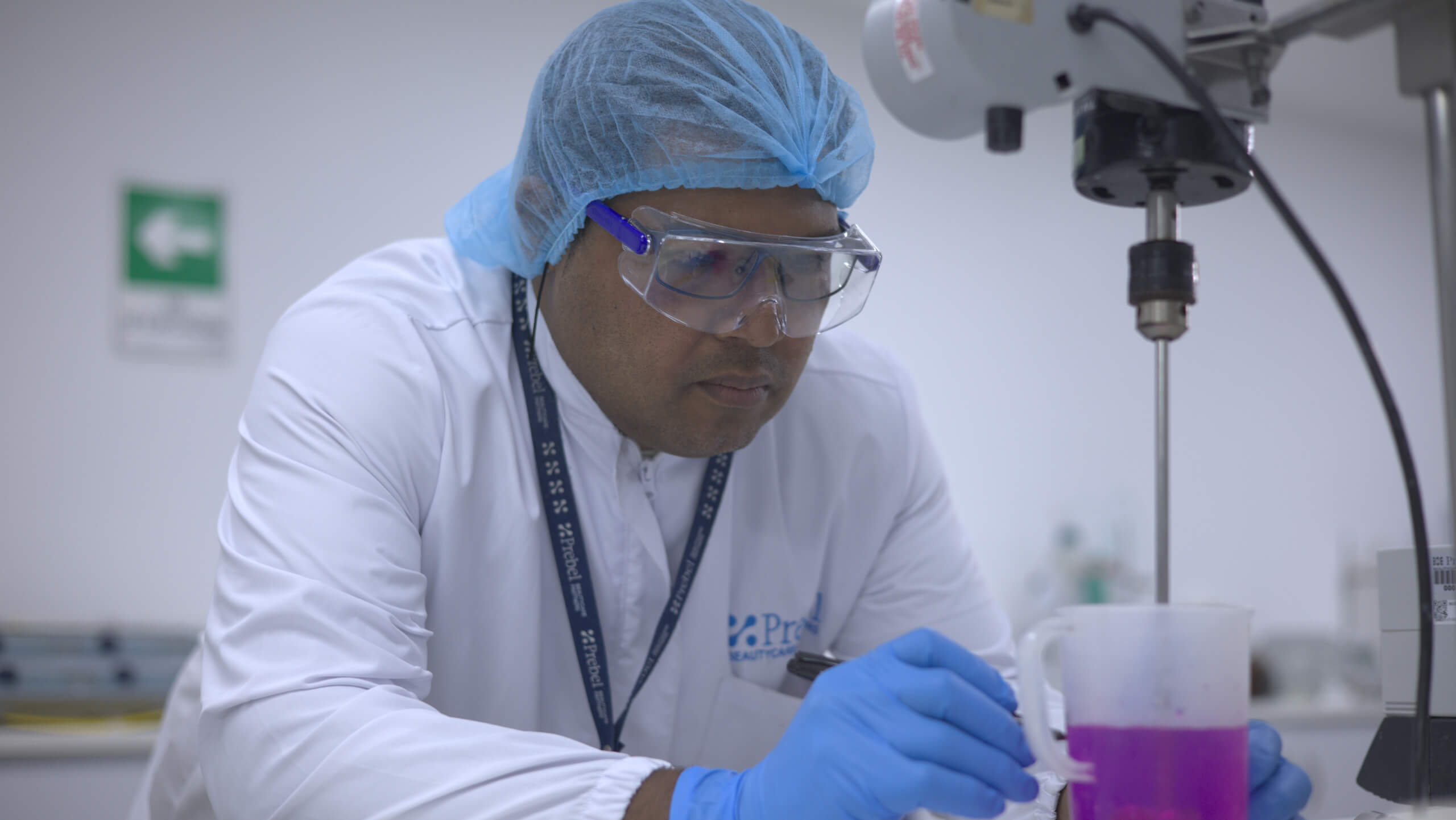
But developing a beauty product involves much more than formulation. From the earliest stages, brands need to address three interconnected questions: what the product will be, how it will be packaged, and how it can be manufactured at the scale the business requires:
- Formula. Defines the product’s texture, efficacy, and stability.
- Packaging. Must be compatible with the specific formula and protect its properties throughout its shelf life.
- Manufacturing. Must be designed to produce the required volume with processes and timelines aligned with the brand’s needs.
Formula, packaging, and manufacturing must be developed together
A beauty product does not reach the market simply because its formula performs well in the laboratory. The formula defines the essence of the product; the packaging helps preserve its properties, attracts consumers at the point of sale, and supports everyday use; and manufacturing makes it possible to produce the volumes required by market demand.
When these three components are developed separately, issues can arise that compromise both the product and the overall project. A formula may perform correctly in the laboratory but experience problems when it comes into contact with the packaging material. A package may fulfill its intended function but prove difficult to produce or fill at scale. Likewise, a formulation that performs well during laboratory testing may require adjustments once it reaches an industrial manufacturing process. What works independently at each stage does not necessarily guarantee that the product will perform successfully as a whole.
The step-by-step process of beauty product development
Beauty product development typically progresses through six defined stages, from the initial brief to full-scale manufacturing. brief hasta la manufactura.
- Brief. The brand defines what it needs, including the product category—such as skincare, makeup, or hair care—the target consumer, the intended benefit, and the desired texture or performance references.
- Formulation. Based on the brief, the formulation team develops the product proposal in the laboratory, adjusting active ingredients, emollients, preservation systems, and other required components until it achieves a prototype that meets the client’s expectations while remaining stable and safe.
- Feasibility. The formula undergoes rigorous stability testing under different temperature and humidity conditions, as well as compatibility studies with the packaging materials selected by the brand and sensory evaluations with real consumers. These tests help determine whether the formula maintains its characteristics and performance within established parameters and whether it is compatible with the packaging system. This evaluation is especially important because some materials may absorb active ingredients or fragrances from the product, while others may release substances, such as plasticizers, into the formula. These potential interactions are evaluated during development to help ensure the quality, safety, and performance of the final product before moving into production.
- Pilot batch. Before producing the full volume, a pilot batch is manufactured. This batch is larger than a laboratory sample but smaller than a complete industrial production run, allowing the team to confirm that the formula performs consistently as production scales.
- Packaging. In parallel with the pilot batch, the packaging team defines and validates the container, assessing whether it can withstand transportation, protect the formula throughout its shelf life, and operate correctly with the facility’s filling system.
- Manufacturing. Once the formula has been validated and the packaging approved, the manufacturing facility schedules production, adjusts its lines to the specific product format, and produces the volume required for the brand’s launch.
Prebel integrates product development and manufacturing within a single process, backed by more than 85 years of experience, technical capabilities, and industry knowledge to turn beauty and personal care projects into market-ready products.
The risks between the laboratory and full-scale manufacturing
Scaling a formula does not simply mean producing more of the same product. Mixing speeds, heating and cooling times, and the pressure generated by industrial equipment differ from laboratory conditions. These differences can alter the final result even when the formula remains identical on paper.
An emulsion that is stable during laboratory testing may separate when transferred to industrial production conditions. If the emulsion is not created under the appropriate manufacturing conditions, the water and oil micelles may fail to stabilize and lose their uniformity. Factors such as a larger mixing vessel, a wider homogenization diameter, or changes in equipment technology during scale-up can alter foam behavior or the viscosity of a formula that appeared suitable in the laboratory.
Anticipating these risks requires specific technical expertise in how formulations behave as production scales. This is why the selection of the right cosmetic manufacturer—and its involvement in product formulation—is so important.
An integrated approach can impact the success of a beauty product
When formulation, packaging, and manufacturing are treated as part of the same project from the beginning, decisions made at each stage take the requirements of the following stages into account. This helps anticipate adjustments, reduce rework, shorten product development timelines, and improve budget accuracy.
For the brand, this means reaching launch with a product that is ready to enter its sales channels in the required quantities, under the agreed quality conditions, and within the expected timeline.
At Prebel, we integrate research, marketing, and manufacturing from the earliest stages of beauty product development. This means that product design decisions consider manufacturing, filling, packaging, and other requirements needed for a successful market launch from the beginning.
For this reason, the value of a CDMO lies not in addressing each stage independently, but in connecting them so that beauty product development can move from formulation to production while remaining aligned with the needs of the business.
We are an advanced CDMO with more than 85 years of experience.
Frequently asked questions about beauty product development
What are the key stages of beauty product development?
Beauty product development includes six stages. The brief defines the product category and objectives; formulation develops the formula in the laboratory; feasibility evaluates stability and packaging compatibility; the pilot batch confirms how the formula performs at a larger scale; packaging is defined and validated in parallel to ensure compatibility with the formula; and manufacturing produces the final volume at the facility.
Why doesn’t a formula that works in the laboratory guarantee a successful product launch?
A successful laboratory result demonstrates that the formula can perform under controlled conditions. However, a successful launch also requires the product to be manufactured consistently, maintain its attributes throughout its shelf life, remain compatible with the selected packaging, and meet technical, sensory, economic, and regulatory expectations.
Laboratory work involves small batches, highly efficient equipment, and almost immediate adjustments. A formulator can closely observe the mixture, modify agitation, correct pH, or manually extend homogenization time. During industrial manufacturing, those conditions change: volumes are significantly larger, equipment has different geometries, and corrections become slower, more costly, and riskier.
What risks can arise when scaling from a laboratory batch to industrial production?
When moving from a laboratory batch to industrial production, mixing, homogenization, and heat-transfer conditions can change, potentially causing lumps, aeration, sedimentation, viscosity variations, instability, or ingredient degradation. The order and speed of ingredient addition, raw material variability, holding times, pumping, filling, and interaction with the packaging can also affect texture, dispensing, stability, and microbiological safety. For this reason, successful scale-up involves more than maintaining the same formula and mixing speeds. Pilot batches are essential for validating critical processing, filling, stability, and packaging compatibility conditions before full-scale manufacturing.
How does an integrated product development approach affect the success of a beauty product?
It reduces the need for adjustments after launch, shortens development timelines, and enables more accurate budget execution while helping ensure that the product reaches sales channels on the agreed launch date.
If you want to learn more about what Prebel can do for your brand, contact us and we will get back to you shortly