What is a CDMO in the beauty and personal care industry
Creating a beauty or personal care product requires decisions about formulation, stability, packaging materials, raw materials, production systems, and regulatory affairs. For a brand, bringing together all the necessary technical knowledge, infrastructure, and specialized talent in-house can be complex and inefficient, not to mention the significant investments it would require. This is why some organizations take on part or all of these functions through a collaborative model known as a CDMO.
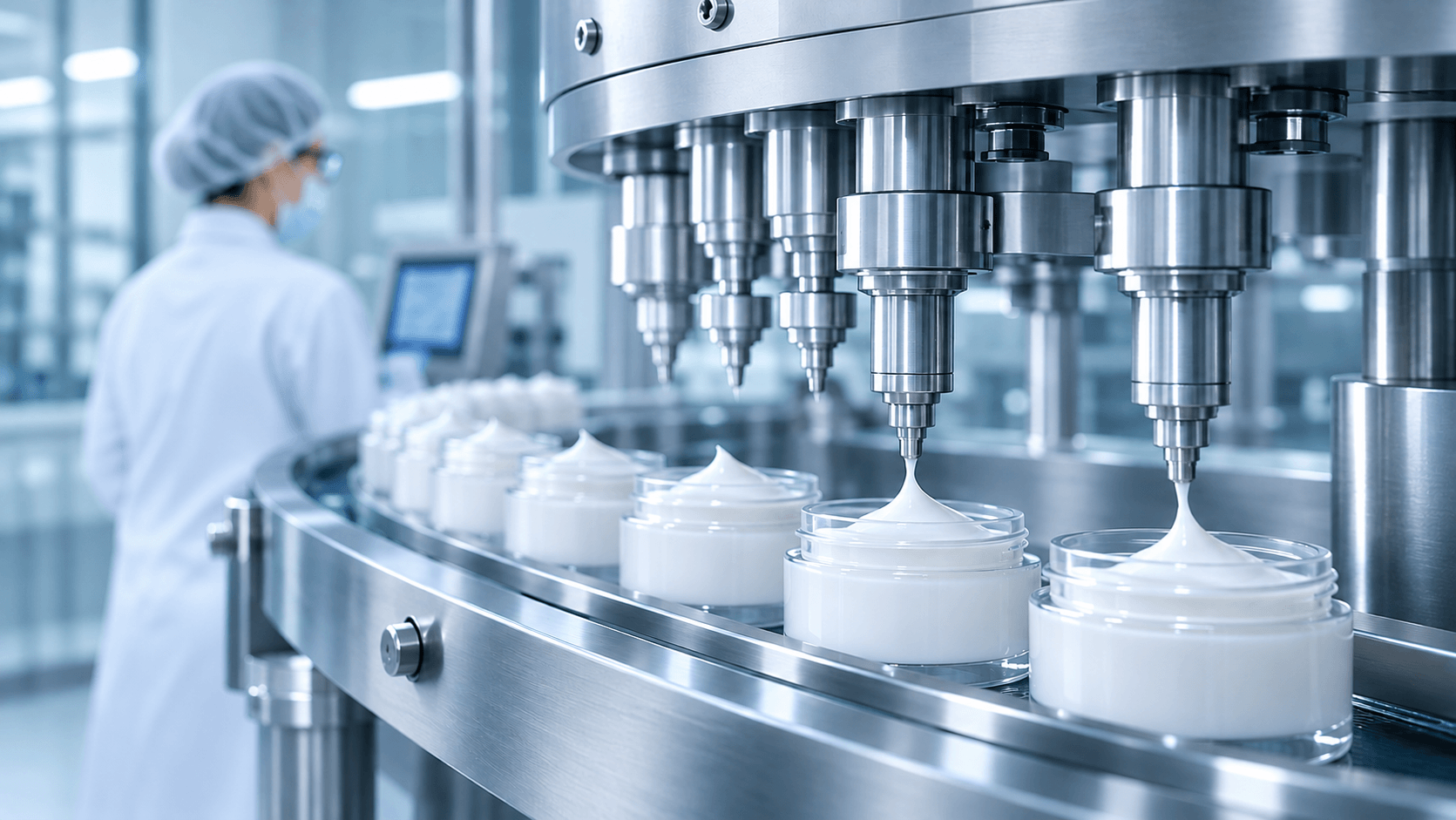
CDMO stands for Contract Development and Manufacturing Organization. In simple terms, it is a company that integrates end-to-end development and manufacturing capabilities for other companies. In the beauty and personal care industry, its role is to connect product development with manufacturing conditions so that decisions made in the laboratory also take industrial-scale production into account.
What is a CDMO in the beauty industry?
A beauty CDMO integrates product development and manufacturing, two services that traditionally could be contracted separately. What sets this model apart is that the product is developed from the outset with the conditions and processes required for industrial-scale manufacturing in mind. This makes it possible to identify, at an early stage, any adjustments that may be needed before commercial production begins.
A CDMO should not be confused with a CMO. While a CMO focuses on manufacturing products whose specifications have already been defined, a CDMO adds development capabilities that allow it to participate in the project from ideation through manufacturing and distribution, providing an end-to-end service that covers these stages according to the scope agreed with each client.
What functions can a CDMO take on in the development and manufacturing of beauty products?
The scope of a CDMO in the beauty and personal care industry is not the same in every case. Some brands may contract specific stages of development and manufacturing, while others look for a comprehensive solution. For this reason, when evaluating a potential partner, it is important to understand exactly which activities in the process it is capable of handling:
1. Brief interpretation
Development begins by defining what the brand expects from its product. The category, target audience, benefit promise, texture, expected performance, packaging materials, and other specifications must be translated into requirements that guide the development and manufacturing process.
2. Beauty product development
The formulation team develops the prototype in the laboratory. The process includes selecting and testing ingredients, combining raw materials, and refining sensory and performance characteristics until a proposal is achieved that meets the defined specifications.
3. Feasibility
The formula must undergo different tests before moving into production. At this stage, factors such as stability under different temperature and humidity conditions, compatibility with packaging materials, and the product’s sensory characteristics are evaluated. These assessments help confirm whether the formula maintains its characteristics and performance within the established parameters and can move on to the next stages of development.
4. Packaging development and validation
A beauty CDMO may develop the packaging in some cases and validates it by considering its interaction with the formula as well as the manufacturing, filling, storage, and transportation conditions the product will face. It is necessary to assess how the formula behaves when it comes into contact with the packaging materials and determine whether that interaction affects characteristics such as stability, odor, appearance, or product performance.
5. Process scale-up
It is necessary to confirm that the formula can be manufactured under conditions that differ from those of a small-scale test. During the scale-up phase, different variables are evaluated and the conditions required to reproduce, at industrial scale, the characteristics achieved during beauty product development are established. This may involve pilot-batch testing and adjustments using higher-capacity equipment before commercial manufacturing begins.
6. Raw material and packaging sourcing
Industrial-scale manufacturing also requires the availability of the ingredients and materials needed for each product. When considering a CDMO, it is important to understand its sourcing capabilities, its relationships with suppliers of raw materials and packaging materials, and its contingency plans in the event that the availability of an input changes.
7. Technical and regulatory information
The services of a beauty and personal care CDMO may include technical and regulatory support. The scope depends on the collaboration model and the responsibilities defined for each project, considering that the development and manufacturing of a cosmetic product require technical information and documentation to support its production and commercialization. In Colombia, cosmetic products must have a Notificación Sanitaria Obligatoria de Cosméticos (NSOC), whose code is assigned by INVIMA.
Now, you may also be interested in reading: The keys redefining the success of a beauty brand
How can you identify whether a manufacturer is truly a CDMO?
Before hiring a CDMO in the beauty and personal care industry, a brand should verify that the offering matches the scope of service it needs and that the capabilities being promoted are supported by infrastructure, equipment, specialized personnel, and proven experience.
Key aspects to review include in-house capabilities for beauty and personal care product development and formulation, the infrastructure available for scale-up and manufacturing, the integration of the different stages of the process, the ability to source raw materials and packaging materials, and compliance with applicable health regulations.
It is also important to review the certifications that support the manufacturing processes and to clearly establish which activities will be handled directly by the CDMO and which will be performed by third parties.
Prebel is an advanced CDMO for the beauty and personal care industry
With more than 85 years of experience, at Prebel we develop, manufacture, and distribute products from Colombia for leading global brands. Today, we operate as an advanced CDMO, with capabilities ranging from product research and development to manufacturing and market launch.
Our work begins with understanding a brand’s needs in order to develop products that can be manufactured and commercialized. To do so, we have scientific and technological capabilities, as well as development and industrial-scale manufacturing expertise. We are supported by a broad network of global suppliers of ingredients and packaging materials, which enables us to offer our clients reliable and timely solutions.
At Prebel, we adapt to the needs of each brand. We can work according to guidelines previously established by the brand or develop a product from scratch, including the entire end-to-end process from ideation through execution. As part of our support for international brands seeking to enter the Colombian market, we can also participate in their market-entry strategy, portfolio design, manufacturing, promotion, and commercialization.
To learn more about the different development models we offer at Prebel, click here..
Key considerations when selecting a CDMO
What is the difference between a CDMO and a traditional manufacturer?
The main difference lies in the scope of the service. A traditional manufacturer focuses on manufacturing, while a CDMO can also participate in beauty product development, from formulation through scale-up and production. A CDMO combines end-to-end development and manufacturing capabilities within a single service solution.
How can a brand confirm that a provider is truly a CDMO?
The best approach is to review the actual scope of its services and verify which capabilities it has directly in-house. Infrastructure, laboratories, production equipment, specialized personnel, and experience with similar projects can help determine whether the offering matches the service the brand needs. It is also important to establish which activities are part of the in-house operation and which are performed by third parties
What can happen when development and manufacturing are not integrated?
The transition from the laboratory to industrial production can reveal differences in formula behavior, require adjustments to process parameters, or create challenges related to packaging materials. These situations may require additional testing, modifications, and extra time before commercial manufacturing can begin. When manufacturing conditions are considered from the early stages of beauty and personal care product development, these variables can be identified and resolved before the product reaches industrial production.
If you have, or are creating, a beauty or personal care brand and are looking for a CDMO to handle the development and manufacturing of your products, contact usand let’s talk about your project.